Last week we completed the pilot installations for the ERICA project, on which we are delighted to be collaborating with the companies Montefrula S.L., La Peña 99 S.L., and the University of La Rioja.
Over the next two years, we will be working closely together to develop and validate a commercial-scale methodology for obtaining a real-time water stress index. The new tool will be based on a leaf-level energy balance, specifically tailored for almond crops in the province of Huesca.
The goal is to optimize irrigation strategies based on objective criteria that allow us to adapt to the new challenges facing the agricultural sector. Given the current situation of increasingly severe weather conditions, water scarcity, and tight profit margins, it is more necessary than ever to maximize water use efficiency, and to that end, the implementation of new technologies—both in terms of sensors and data processing—is essential to support rational decision-making.
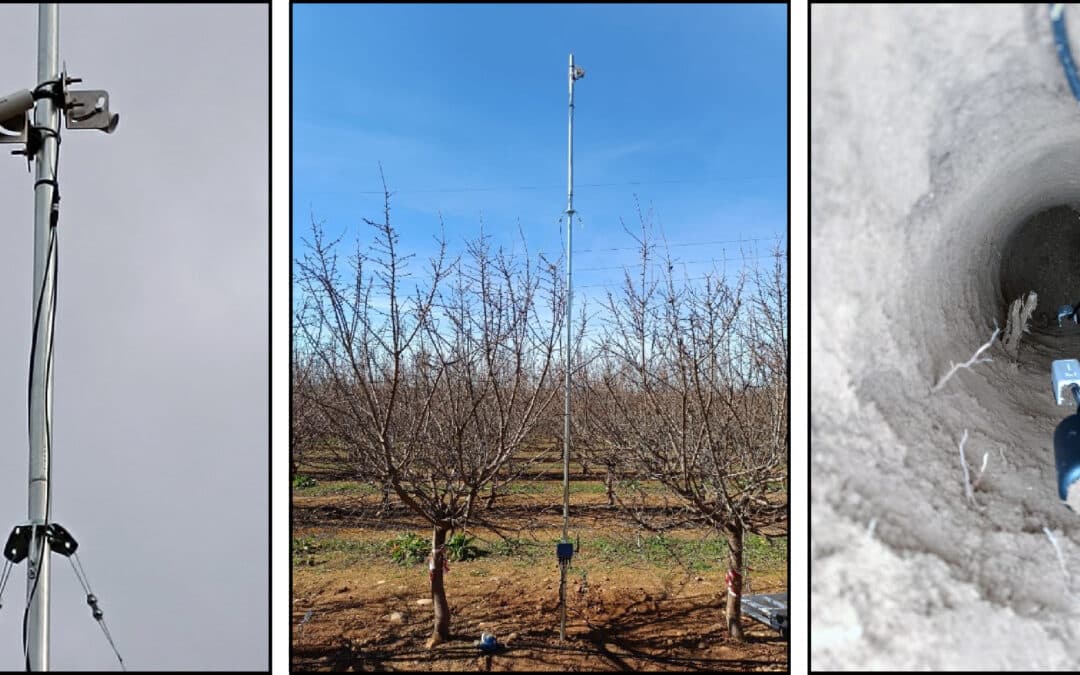
Below are some photos of the installation process of the measurement elements on which the tool will be based: these are IRT sensors capable of recording the actual temperature of the crop based on the radiated energy. By adjusting the height above the canopy and the angle of the cameras, we have managed to obtain a field of view that includes continuous vegetation (accuracy) and at least two complete trees (representativeness) at each measurement point. We are already recording the first readings, and although they appear consistent, we still need to implement a correction in the software that accounts for emissivity and reflected background radiation to ensure their reliability.
In addition to these direct-measurement sensors, other auxiliary devices have been installed to monitor the soil and climate conditions, such as volumetric soil moisture probes, weather stations, and flow meters. This will allow for precise monitoring of the three irrigation treatments (with different levels of water deficit) that have been proposed for the experiment, as well as the two extreme cases (trees without water/trees without water restriction) that will be used to obtain accurate baseline measurements. The experiment consists of two replicates on two different plots located about 30 km apart, both with continuous hedgerows of the “Penta” variety.