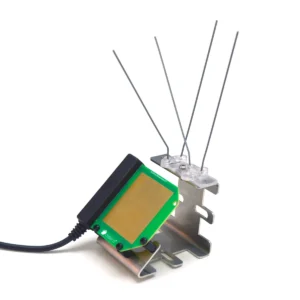
The initiative led by Bodegas Pagos de Araiz S.A.—in collaboration with Bodega Otazu SAU, the Department of Rural Development and the Environment (Viticulture and Oenology Section), Bodega Cirbonera S.C., and UAGN, which was dedicated to developing a reliable tool for controlling powdery mildew in Navarran vineyards
The Oivina project has come to a successful conclusion. The data collected and presented on December 13 at Evena (Olite) confirm this: the tool developed over the past few months for the early detection of powdery mildew works.
The event began with a presentation by Jesús Astrain Zaratiegui, a viticulture specialist at Bodegas Pagos de Araiz, who provided context for the attendees by explaining the project’s concept. Astrain focused on the methodology for data collection and the design of field trials. “The five organizations participating in the project collected data in five geographic areas by setting up weather stations,” he explained. His remarks were supported by Jorge Blázquez of Ager Technology, who described how his team collected the information using an app deployed in the fields.
Next, Nicolás Molina and Samuel Martínez, agricultural engineers at CESENS, took the floor and detailed the features of the tool they had developed. “We started with a model from the University of California and adapted it to the parameters of Navarre. We’ve achieved what we set out to do—obtaining predictive data on the pest—but a single growing season isn’t enough because weather conditions and other factors change from one year to the next. The only thing left to do is test the tool over a longer period, across multiple growing seasons, to gather more and more accurate information that will allow for more realistic comparisons.”
These presentations were followed by audience participation during the roundtable discussion, “Sustainable Viticulture Practices,” moderated by Iñaki Mendioroz, director of sectors, projects, and innovation at UAGN, with contributions from Nazareth Torres, a researcher at UPNA; Félix Cibrirain of Evena; Aitziber Larrea of Bodega Otazu; and Jesús Astráin of Bodegas Pagos de Araiz.
This brings to a close a period in which The objectives set are considered to have been met: to develop a device tailored to each location and capable of providing a reliable forecast of powdery mildew—caused by the fungus Uncinula necator—which can result in significant crop losses and economic impacts. A tool aligned with the Europe 2030 strategy and, in this vein, a project under the 2014–2020 Navarre Rural Development Program, 90% of which is funded by the EU through the EAFRD, with the Government of Navarre providing 65% and 35% of the co-financing, respectively.