
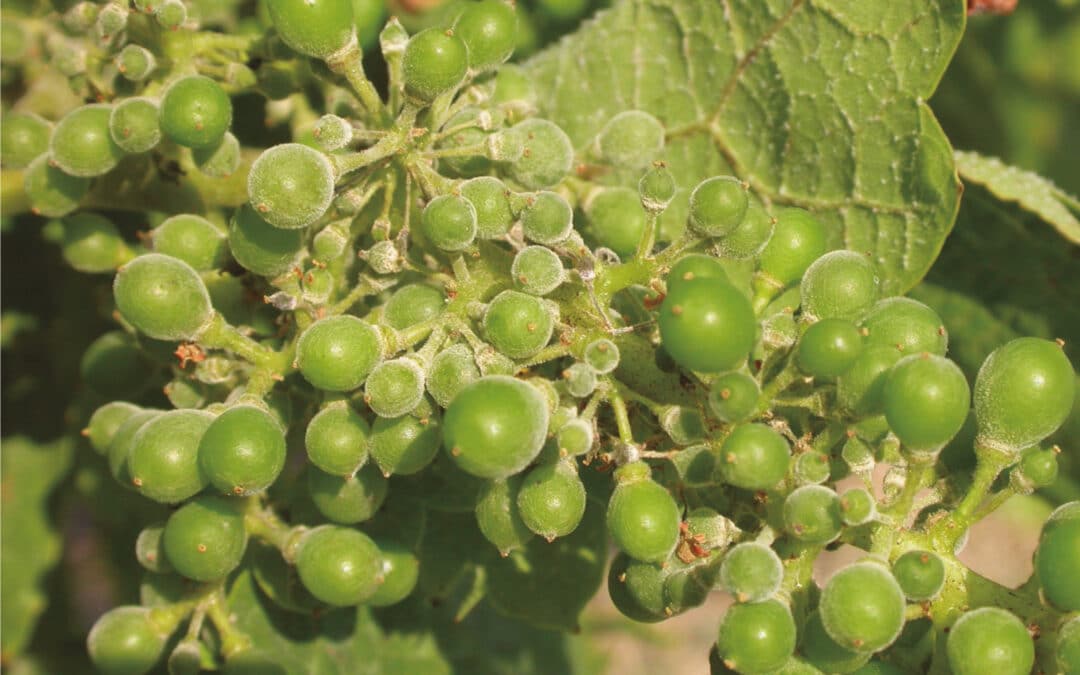
Predictive model to combat powdery mildew in grapevines
“Navarra Agraria” is a technical agricultural journal aimed at transferring to the agri-food sector the knowledge generated through INTIA’s experimental and R&D activities and those of the networks in which INTIA participates.
Issue 252 features the OIVINA project, in which Cesens participates, and whose main objective is to develop a predictive model for powdery mildew adapted to the agroclimatic conditions of Navarra, taking into account the cultural practices carried out in the vineyard.
Powdery mildew is undoubtedly the endemic parasitic disease that, since its arrival in Europe, has had the greatest economic impact on the wine industry.
In 1850, the first outbreaks were reported in Spain, in Navarre and La Rioja. It is known that outbreaks of “cenicilla” or “plomo”—the local names used to identify the new disease—between 1856 and 1864 forced the uprooting of a large portion of the vineyards, which at that time consisted of Mazuelas, Tempranillo, Berués, and other varieties susceptible to the disease, which were largely replaced by Garnacha, a much more resistant variety.
OIVINA aims to implement and combine precision agriculture technologies, such as agroclimatic information systems, sensor-based systems, and other technologies that facilitate the collection of data from the plots under study to obtain relevant information.
To achieve this stated goal, the following specific objectives are also proposed:
- Establishment of the study plot network.
- Deployment of Cesens agroclimatic stations.
- Collection of georeferenced data.
Results and full article available at the following link: